Coil Academy / Maintenance
How Long Do Commercial HVAC Coils Last?
What lifespan estimates mean, why some coils fail early, and how to plan around the condition of your equipment.
In this article10 sections
Age is only part of the picture
Commercial HVAC coils do not have a fixed expiration date. A published service-life table lists about 20 years for DX, water, and steam coils. That is useful planning context, not a promise that an individual coil will reach that age or a reason to replace one that still works well.
For an existing coil, the more useful question is how it is holding up. Its environment, fluid conditions, installation, and maintenance can matter more than the date on the equipment. This guide explains what changes service life and what to review before budgeting for replacement.
Use a lifespan estimate for planning
A service-life estimate helps a building owner think ahead about future costs. It does not predict the failure date of a particular component. The 20-year figure groups several coil applications together: DX coils contain refrigerant, water coils contain hot or chilled water, and steam coils heat air using steam. It is not a model-specific rating.
It also matters what a published number describes. A coil, a fan-coil unit, an air-cooled condenser assembly, and a complete rooftop unit are different items. An expected life for the whole machine should not automatically be assigned to one coil inside it.
Think of age like the mileage on a used vehicle. It gives you context, but service records and an inspection tell you much more about its present condition. Two vehicles with the same mileage can need very different work. The same is true of two coils installed in the same year.
Separate lost performance from permanent damage
A coil has two jobs that depend on its condition: contain the working fluid and transfer heat. It may develop a leak, lose useful fin material, or become obstructed by deposits. Those are different problems, and they do not all mean the coil has reached the end of its service life.
Cleaning may restore performance lost to removable dirt. It cannot put missing metal back or repair a leaking tube. A coil that looks cleaner afterward is not necessarily structurally sound. Conversely, poor heating or cooling does not prove that the coil is worn out; airflow, controls, and the rest of the system need checking too.
A useful assessment separates what can be corrected through service from deterioration that remains after the service is complete.
The surrounding air can shorten service life
The air reaching the coil carries more than heat. Coastal salt, industrial contaminants, and moisture can create conditions that attack exposed metals. A coil in a sheltered, relatively clean air handler faces a different environment from an outdoor coil near salt spray or a contaminated exhaust source.
Corrosion can remove metal from fins or tubing, and some forms attack small areas rather than spreading evenly. That is why surface appearance alone cannot establish how much sound material remains. Green copper discoloration or rust on a casing is a reason to investigate, not a complete diagnosis of the coil’s condition.
An indoor location is not a guarantee of a mild environment. Review the air the equipment actually receives, including outdoor air and nearby contaminant sources.
Same age. Different exposure.
The same equipment can face different exposure. Location alone does not establish condition or years remaining.
Conditions inside the tubes matter too
For hot-water and chilled-water coils, the fluid circuit needs attention as well as the visible fins. Unsuitable water conditions can contribute to corrosion or deposits inside the passages. A water-treatment specialist should evaluate the system and the requirements of its materials. Do not assume a coil is protected internally because its outside looks clean.
Steam coils have another concern: the water left when steam condenses must drain properly. Under some operating conditions, there may not be enough pressure difference to move that condensate through the trap. This is called stall. Condensate can back up even when the trap itself works. The result can include corrosion, damaging pressure shocks, or freezing exposure.
The lesson is practical: caring for the coil includes caring for the system connected to it. Replacing a coil without correcting an ongoing fluid or drainage problem can expose the replacement to the same cause.
The inside matters too
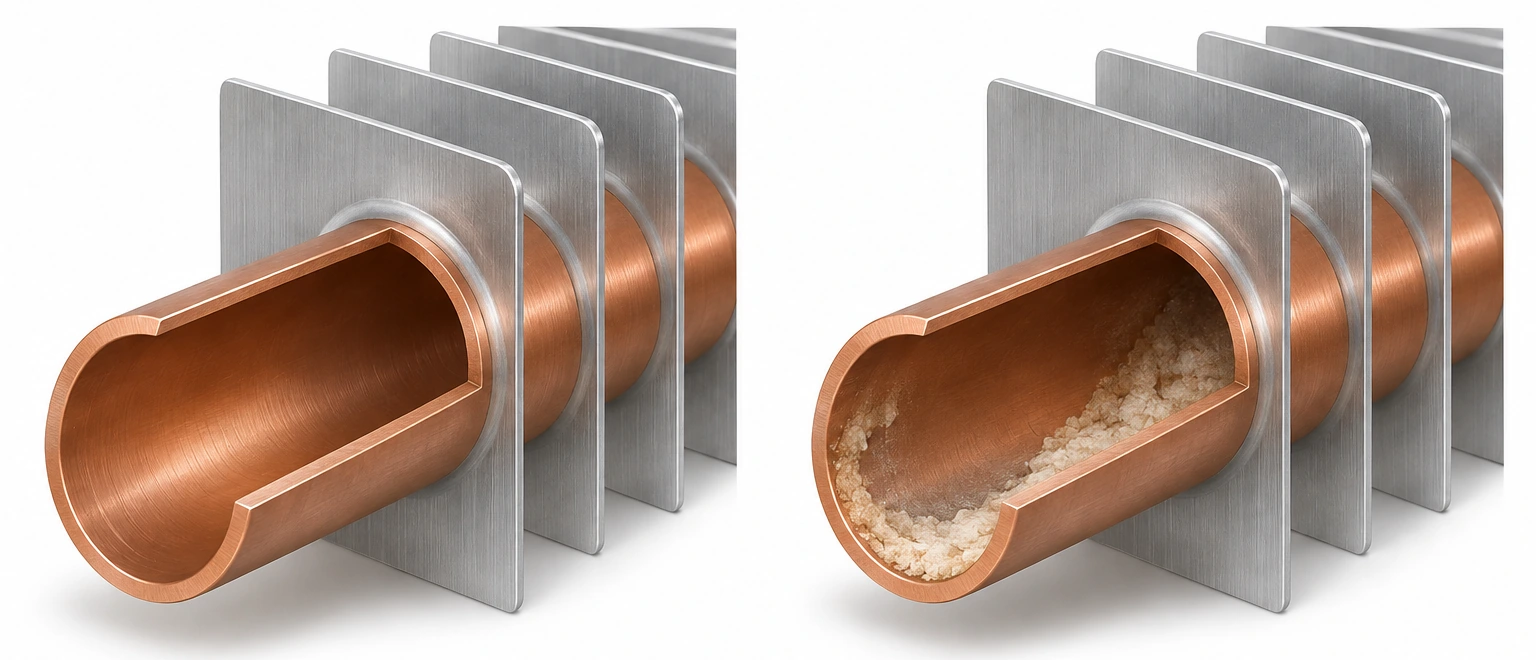
Clean-looking fins do not reveal the condition inside the tubes. The cutaway and deposits are illustrative, not a diagnosis of a particular coil.
A sudden failure is different from gradual aging
A water-filled coil can rupture if the water inside freezes. Loss of circulation or heat, a power interruption, or failed protective controls can create the conditions for damage. A relatively new coil can therefore fail without having gradually worn out. The cause needs investigation alongside the damaged coil.
Ice on the outside of a refrigerant evaporator is a different observation. Airflow restrictions or refrigerant-system problems can cause surface icing. Visible ice alone does not establish that the tubes have ruptured or that replacement is necessary. Have the cause diagnosed rather than treating every frozen-looking coil as the same failure.
Repeated vibration and temperature cycling can also affect coil integrity over time. Unusual movement, noise, or repeated connection problems deserve attention; they should not be dismissed simply because the coil is young.
Maintenance should preserve the coil
Use the equipment manufacturer’s instructions to set the inspection and cleaning plan, then account for actual exposure. A frequently contaminated site may need more attention than a clean one. Inspection and cleaning are different activities: inspect to establish what is needed, and follow any prescribed cleaning schedule for the equipment or coating.
The method matters as much as the schedule. Use cleaners, water conditions, and application methods approved for the coil’s materials and coating. Excessive force or an unsuitable chemical can damage the surfaces the cleaning was meant to preserve. More aggressive cleaning is not automatically better maintenance.
Include drainage and surrounding equipment in the service review. Record what was found, what was done, and what remains unresolved. Maintenance can address removable contamination and correctable operating problems; it cannot reverse extensive metal loss.
Coatings need care as well
A suitable protective coating can form a barrier between the metal and a corrosive environment. It is one part of a protection strategy, not a guarantee of a particular number of extra years. Selection needs to account for the actual exposure and the coating’s intended use.
Coated coils still require maintenance. Follow the coating supplier’s cleaning instructions, inspect for damage, and use the prescribed repair process where needed. Some coating programs also require maintenance records. A coating does not replace attention to water quality or freeze protection inside the coil.
Keep three separate ideas clear: estimated service life, observed condition, and warranty coverage. A warranty period is not an expiration date, and a planning estimate is not a warranty.
Look for a pattern rather than one symptom
A useful condition review considers confirmed leaks, recurring repair locations, the extent of fin and tube deterioration, and performance after correctable service issues have been addressed. Compare findings over time when records are available. Repeated failures deserve a broader assessment than another isolated patch.
Changes in comfort or energy use can justify an investigation, but they do not identify the coil as the cause by themselves. A blocked filter, a fan problem, or an operating condition can also affect the result. Diagnose before assigning the problem to age.
A photograph or a successful leak test cannot, by itself, establish exactly how many years remain. Ask the service team what it can confirm, what it cannot see, and what would change its recommendation.
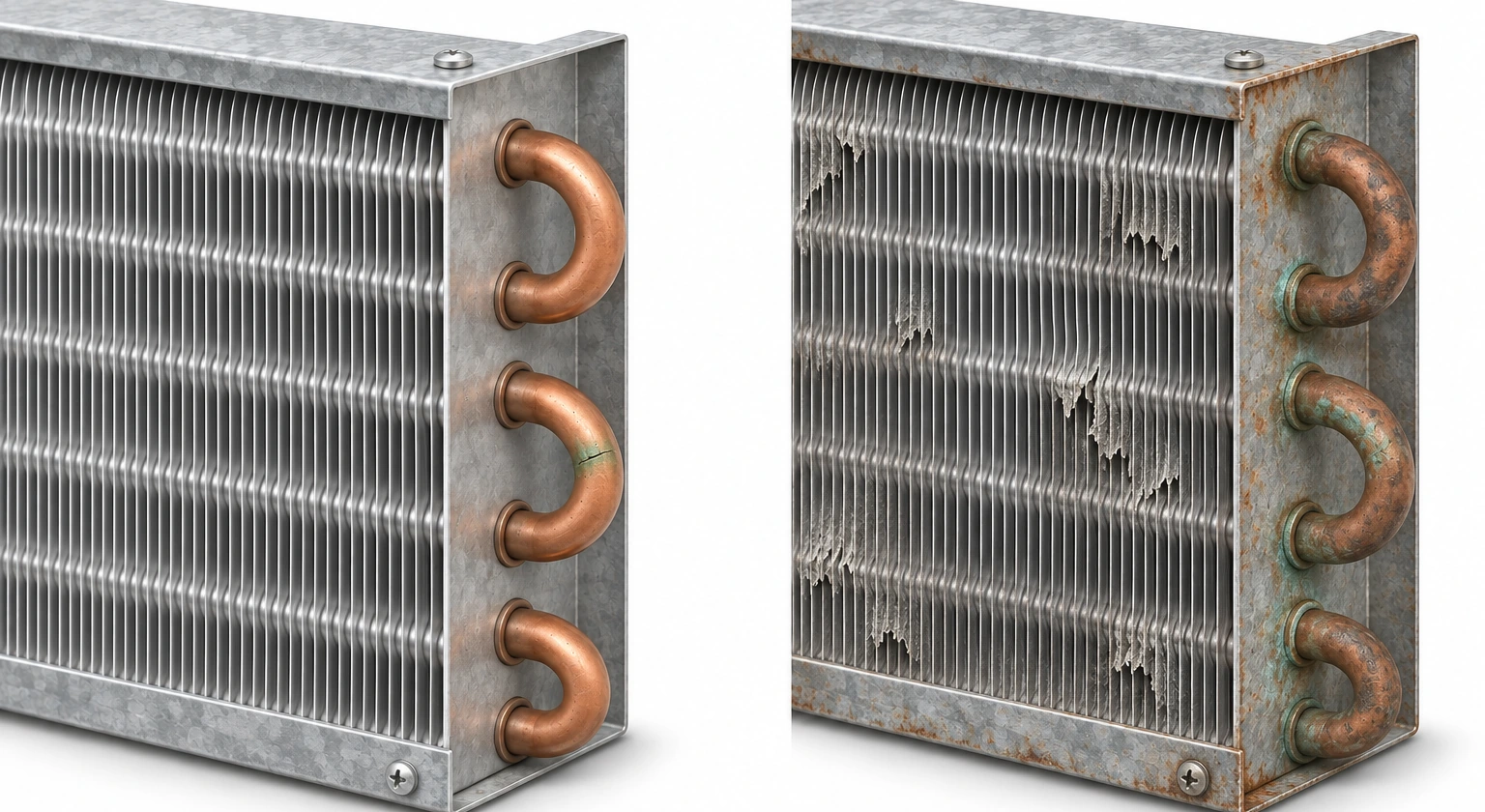
Assess the extent and pattern of deterioration. This illustration does not establish the age or remaining life of either coil.
Plan around condition and the cost of an interruption
Age is most useful when it starts a planning conversation before an emergency. Gather the installation date if known, maintenance history, previous repairs, and photographs. Ask a qualified service team to assess the coil and the equipment around it. If replacement may be needed, investigate access and current lead times before the next critical operating period.
The same uncertainty can lead to different plans in different buildings. An owner with backup equipment may be able to monitor a serviceable coil. A facility that cannot tolerate an unplanned shutdown may reasonably prepare a replacement plan earlier. That is a decision about operational risk, not proof that the coil will fail tomorrow.
Useful questions for the review include
- Is there confirmed damage, or an operating problem that can be corrected?
- What has changed since the last inspection or repair?
- Are deterioration or leaks isolated or spread across the coil?
- What environmental or system conditions could damage it again?
- What would an unexpected shutdown affect, and is backup available?
- What access, delivery, and installation arrangements would replacement require?
Do not subtract the coil’s age from a generic estimate and treat the result as remaining life. An older, serviceable coil and a younger, deteriorating coil call for different decisions. Use age to prepare the budget, and use diagnosis, condition, and operating risk to decide what happens next.
For a closer look at service options, read Repair or Replace an HVAC Coil?
Coil Recall
Review the article’s main ideas, one card at a time.
Card 1 of 7