Coil Academy / Coil Basics
Hot-Water vs. Chilled-Water Coils, Explained
Learn how each coil changes the air temperature, why cooling can also remove moisture, and what the two types have in common.
In this article10 sections
Hot-water and chilled-water coils can look almost identical: tubes, closely spaced metal fins, a casing, and water connections. Their names describe what they do in the system.
A hot-water coil gives heat from the water to the air. A chilled-water coil takes heat from the air and transfers it to the water. If the cooling surface is cold enough, it can also remove moisture from the air.
The main difference is the direction heat moves. Neither coil creates heat or cold on its own.
Both are hydronic coils
Both types carry water, or a suitable mixture of water and glycol, through their tubes. Air passes outside the tubes and between the fins. A system that uses liquid to carry heat is called hydronic.
Think of a metal spoon resting in hot coffee. Heat moves from the coffee into the spoon and through the metal. A coil also transfers heat through metal, while keeping the water inside its tubes separate from the air outside.
The tubes carry the water. The thin metal fins give the passing air more surface to exchange heat with. Think of a towel spread out rather than folded: spreading it exposes more surface to the air. Fins provide extra metal surface around the tubes.
Headers are the larger pipes that distribute water into the smaller tube paths and collect it again. Those paths are called circuits. The casing is the frame that supports the assembly.
A fan moves the air and a pump circulates the water. They belong to the surrounding system; the finned coil itself does not contain a fan or a pump. During normal operation, water stays inside the tubes and does not spray into the air.
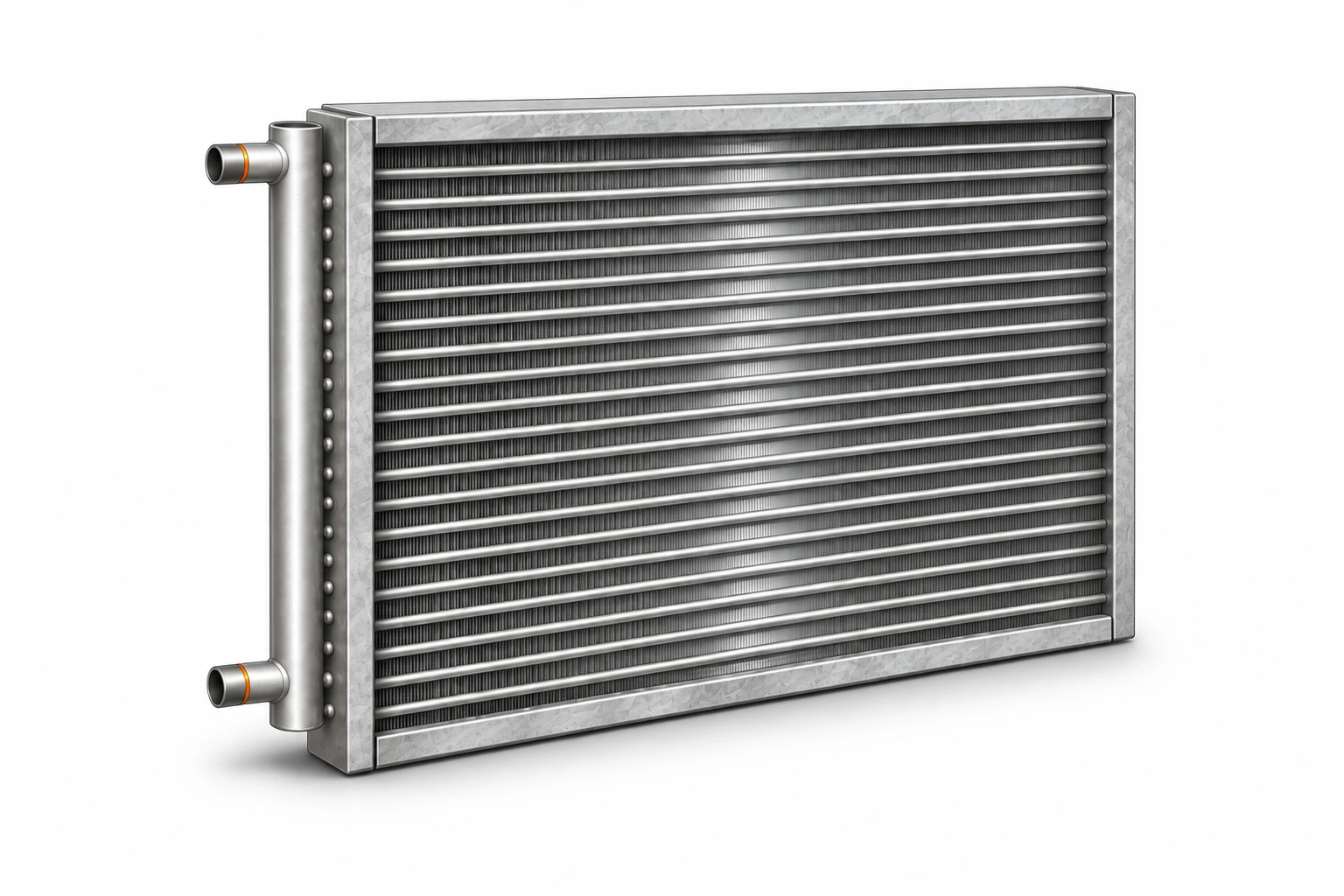
How a hot-water coil warms the air
Water enters the coil warmer than the air passing over it. Heat moves from the water, through the tubes and fins, and into the air. The air leaves warmer. The water normally leaves cooler because it has given up some of its heat.
That heat comes from elsewhere, such as a boiler, a heat pump, or a district heating network. The coil transfers some of it to the air.
Hot-water coils can warm incoming outdoor air or heat air for a building or zone. They can also warm air that has already been cooled; this is called reheat. Small heating coils installed in ducts are sometimes called booster coils.
Warming air does not remove its water vapor. Its relative humidity can fall as it warms, even though the amount of moisture has not changed. To remove moisture, the system needs another process, such as condensation at a cooling coil.
How a chilled-water coil cools the air
Water enters the coil colder than the air passing over it. Heat moves from the air, through the metal, and into the water. The air leaves cooler. The water normally leaves warmer because it has absorbed heat.
The water then returns to equipment that removes that heat, commonly a chiller, before circulating again. A district chilled-water system or a suitable heat-pump system can also provide the cooling water.
This differs from a direct-expansion, or DX, evaporator coil. A chilled-water coil carries water through its tubes. A DX coil carries refrigerant that evaporates inside them. Both can cool air, but they connect to different systems.
Despite the name chilled water, the water should remain liquid during normal operation. Freezing inside the coil can cause damage.
Why cooling can also remove moisture
Water on the outside of a cold glass comes from moisture in the surrounding air. A chilled-water coil can collect moisture for the same reason.
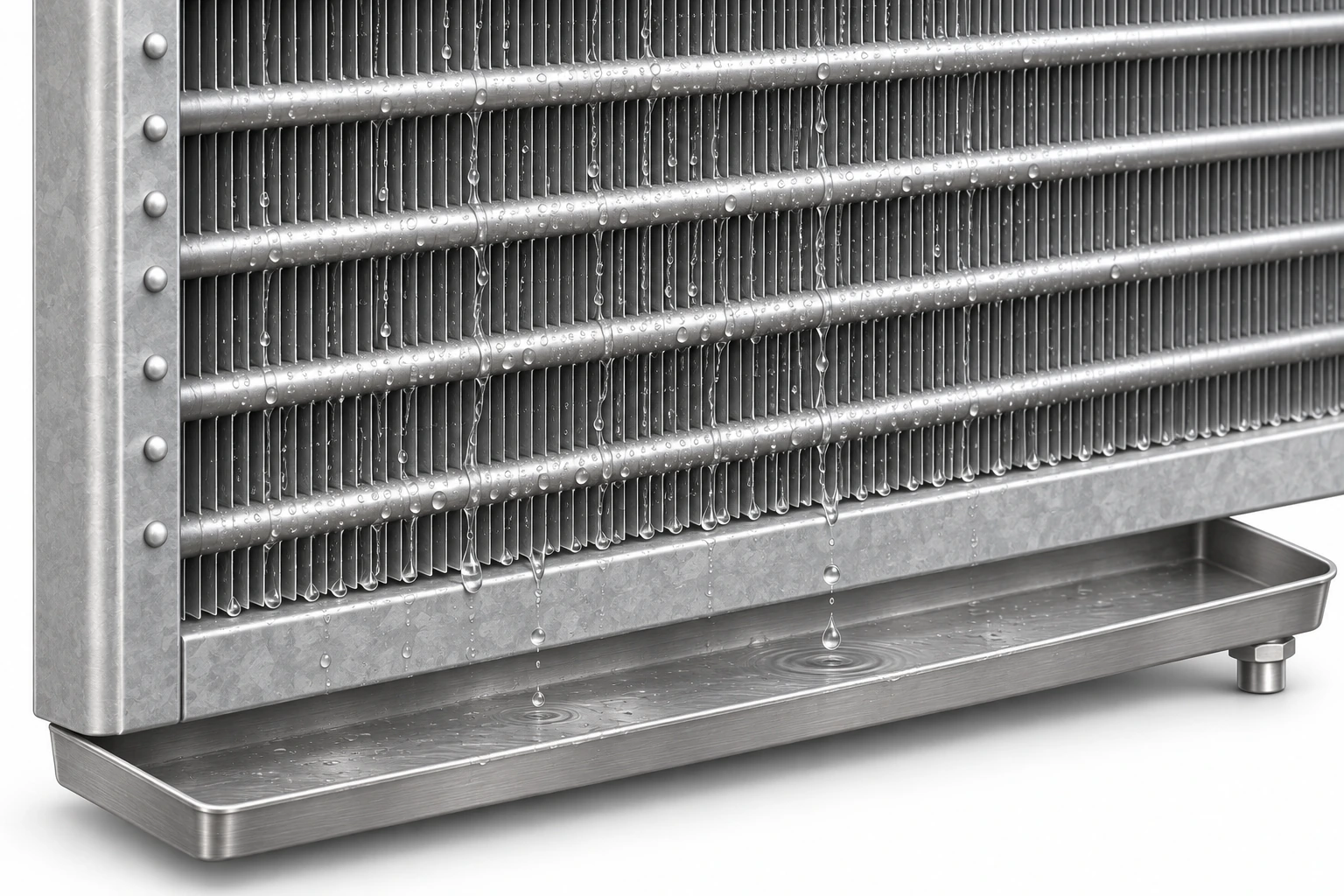
As air cools, it can reach a temperature at which some of its water vapor becomes liquid. This temperature is called the dew point. Where the coil surface is below the dew point of the air touching it, moisture can condense on the fins and tubes. The droplets collect in a condensate pan below and leave through a drain.
That water comes from the air, not from inside the coil tubes. Normal condensation does not, by itself, mean the coil is leaking.
Lowering the air temperature is called sensible cooling. The heat removed when moisture condenses is called latent cooling. A wet cooling coil can do both. Removing moisture from air is called dehumidification.
A chilled-water coil does not always remove moisture. If its surface stays above the air's dew point, it can cool the air without condensation. How much moisture it removes depends on the incoming air, surface temperature, airflow, and coil design. The coil alone does not guarantee a particular humidity in the room.
The basic differences at a glance
Scroll horizontally to compare all columns on small screens.
| Comparison | Hot-water coil | Chilled-water coil |
|---|---|---|
| Main job | Warm the air | Cool the air |
| Heat moves | From water to air | From air to water |
| Water leaving the coil | Normally cooler during heating | Normally warmer during cooling |
| Moisture removal | Heating alone does not remove water vapor | Possible when the surface is cold enough for condensation |
| Condensate collection | Normally unnecessary for heating alone | Needed where cooling produces condensation |
| Common applications | Heating, preheating, and reheat | Air cooling and dehumidification |
Why the coils can look similar
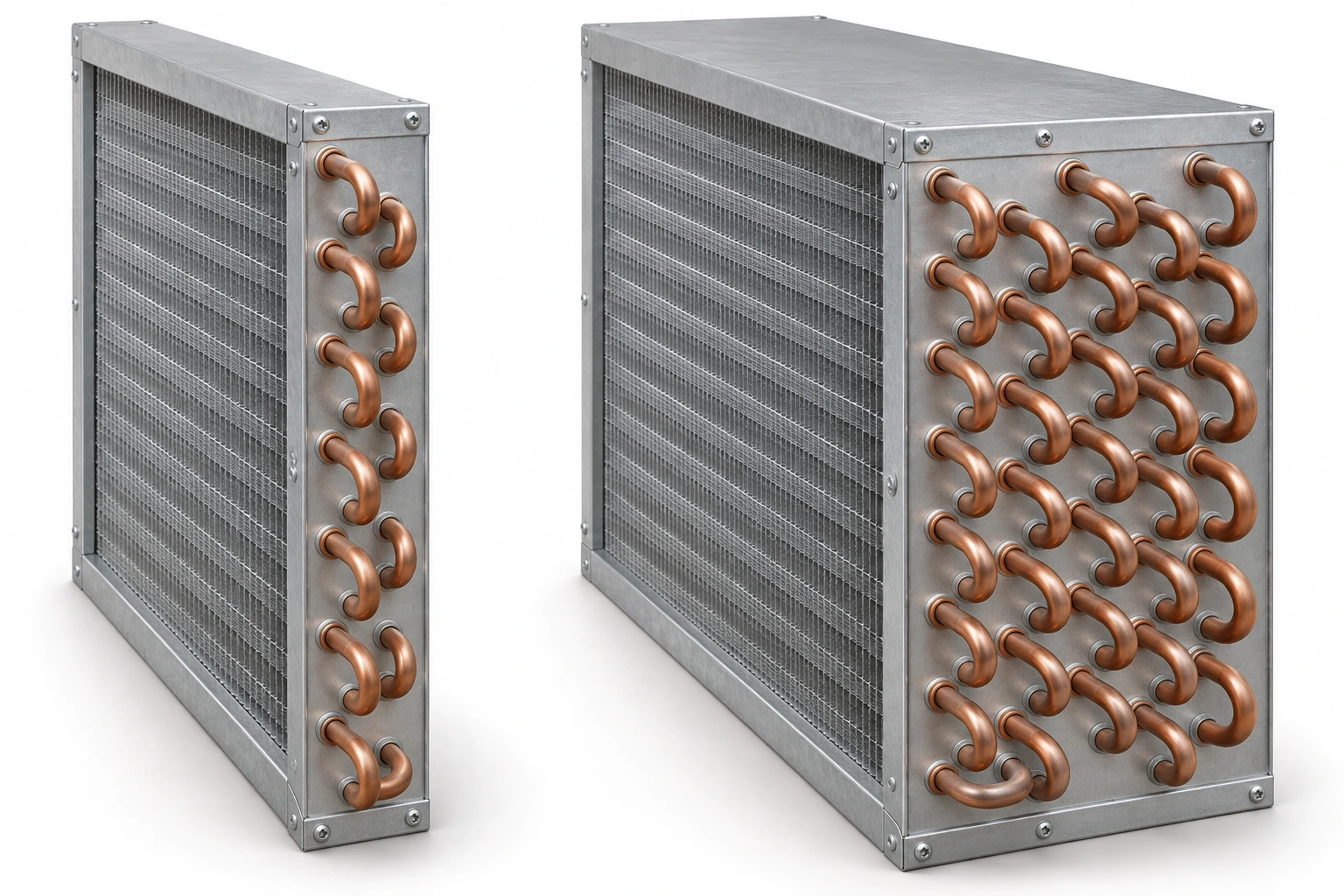
Both types use the same basic parts. Their tube sizes, materials, fin spacing, header positions, and depths can vary. Rows are the layers of tubes through the coil's depth, from the side where air enters to the side where it leaves.
Heating coils are often shallower. In many heating applications, the water is much warmer than the air, so relatively few rows can transfer the needed heat. Cooling and moisture removal often call for deeper coils with more rows.
These are common patterns, not rules. A hot-water coil can have several rows, and heating and cooling designs can overlap. You cannot reliably identify a coil's job from its depth or connection positions alone.
Two coils with similar outer dimensions can also perform differently. Their fins and the way water travels through their tubes affect how they exchange heat.
What affects how much heating or cooling a coil provides?
Several conditions work together. Changing one can change the result, even when the coil itself stays the same.
Airflow is the amount of air passing through the coil. It affects heat transfer, the temperature of the air leaving, and how hard the fan must work to move air through the fins. More airflow does not automatically mean warmer or colder air at the outlet.
Water temperature sets the temperature difference between the water and air. Hotter water can help a heating coil transfer more heat. Colder water can help a cooling coil take more heat from the air and may allow more moisture to condense. The result still depends on the other conditions.
Water flow is the amount of water moving through the coil. Inside, that flow divides among tube paths, or circuits. Circuiting describes how those paths are arranged and connected. The same total water flow can travel at different speeds inside the tubes of different coil designs.
Water also loses pressure as it travels through the coil. This resistance is called water-side pressure drop, and the pump must work against it. Resistance to air passing between the fins is separate; the fan works against that resistance.
More rows and more closely spaced fins can provide extra heat-transfer surface, but they also affect resistance to airflow and access for cleaning. These details explain why appearance alone cannot tell you how a coil will perform.
What supply and return mean
Supply is the water arriving at the coil. Return is the water leaving it to go back into the system.
For heating, supply water is normally hotter than return water. For cooling, supply water is normally colder than return water. The names describe where the water is going; they do not mean that a connection is always hot or always cold.
Optional: What is counterflow?
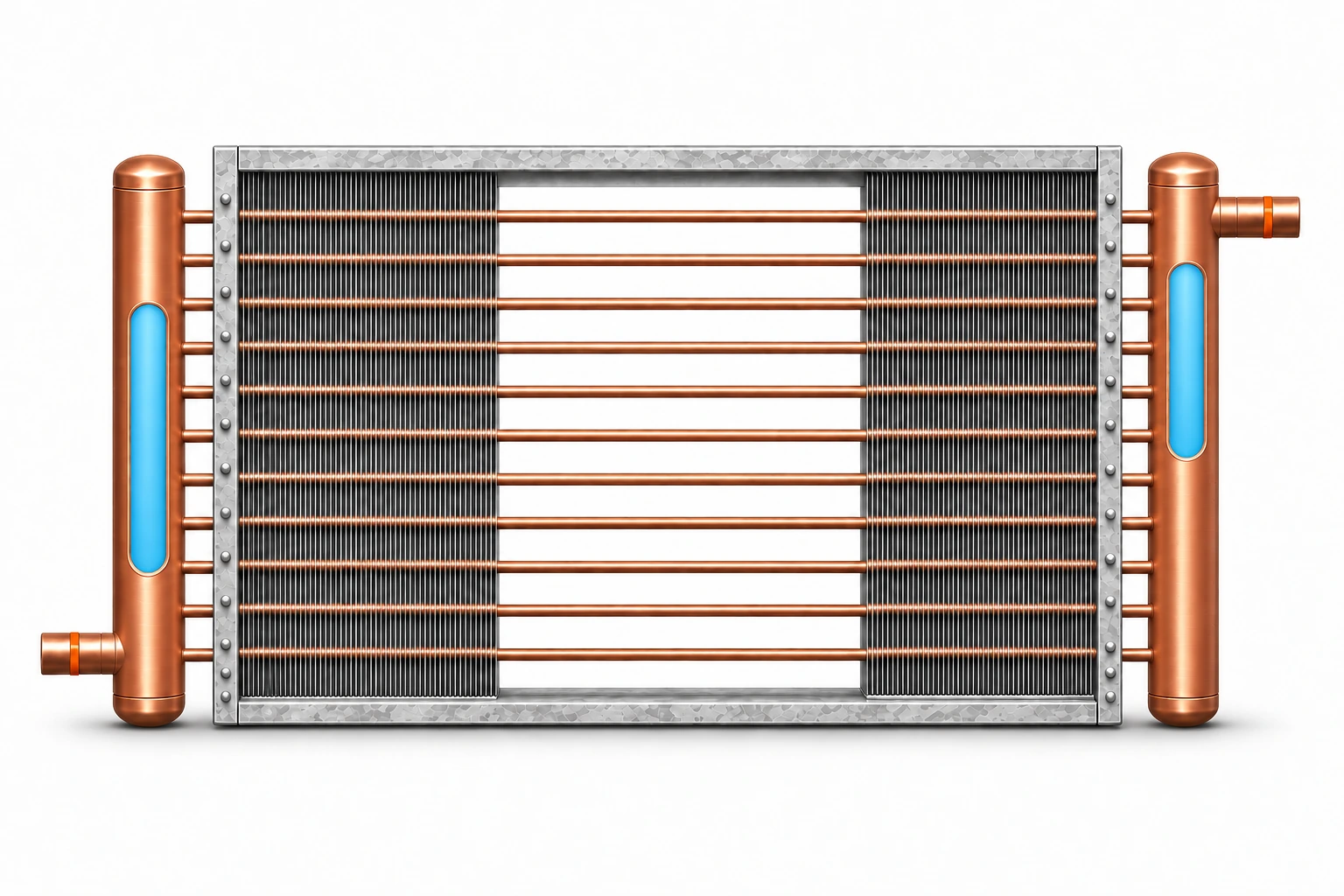
In many coils with several rows, the water moves through the coil's depth in the opposite overall direction to the air. This arrangement is called thermal counterflow. It helps maintain a useful temperature difference for heat transfer as the air and water pass through the coil.
The water turns through connected tube passes, so this does not mean every individual tube points directly against the air. Counterflow describes the overall progression through the rows.
The airflow direction, water connections, and internal circuits must be considered together. The equipment or coil drawing shows the intended orientation.
Can heating and cooling coils work together?
Yes. Some systems use one coil designed to receive hot or chilled water at different times. Others use separate coils. Separate coils can also work in sequence: a cooling coil cools the air and can remove moisture, then a hot-water coil reheats it. Reheating raises the temperature without adding the removed moisture back.
Where glycol and freeze protection fit
Glycol is a liquid that can be mixed with water to lower its freezing point. Both heating and cooling systems may use these mixtures. The type and amount of glycol affect heat transfer and how easily the mixture moves through the coil.
The two common types are ethylene glycol and propylene glycol. At comparable temperatures and concentrations, ethylene glycol mixtures are generally less viscous—meaning they flow more easily—and transfer heat more efficiently. Propylene glycol has lower toxicity than ethylene glycol and is often chosen where that matters. The choice depends on the application, possible exposure, and the equipment's fluid requirements. The complete formulation, including its additives, must suit the system.
A heating coil is not automatically protected from freezing. If it is exposed to freezing air and its water gets cold enough, it can be damaged. This can happen during a shutdown or if circulation or the heat supply stops. Cooling coils can also face freezing conditions.
Freeze protection depends on the installation. Glycol, controls, equipment arrangement, and maintenance procedures can all play a part. The coil's name alone does not tell you whether it is protected.
Coil Recall
Review the article’s main ideas, one card at a time.
Card 1 of 7