Coil Academy / Coil Basics
Ethylene Glycol vs Propylene Glycol Explained
Understand the two common glycol mixtures used in heating and cooling systems, why they behave differently, and what matters when choosing between them.
In this article11 sections
Water is good at carrying heat, but it can freeze. In a heating or cooling system exposed to low temperatures, that can damage a coil or interrupt operation. Adding a suitable glycol changes the temperature at which ice begins to form.
The two common choices are ethylene glycol and propylene glycol. Both can provide freeze protection when correctly formulated and mixed with water. Their main differences concern toxicity and how easily their mixtures flow, especially when cold.
Ethylene glycol often offers a performance advantage. Propylene glycol is often preferred where lower toxicity matters. Neither is the right choice for every system, and the name of the base chemical tells only part of the story.
What glycol does inside a coil
Glycols are a family of liquid chemicals. In HVAC, which means heating, ventilation, and air conditioning, ethylene glycol and propylene glycol are commonly used as ingredients in fluids that carry heat.
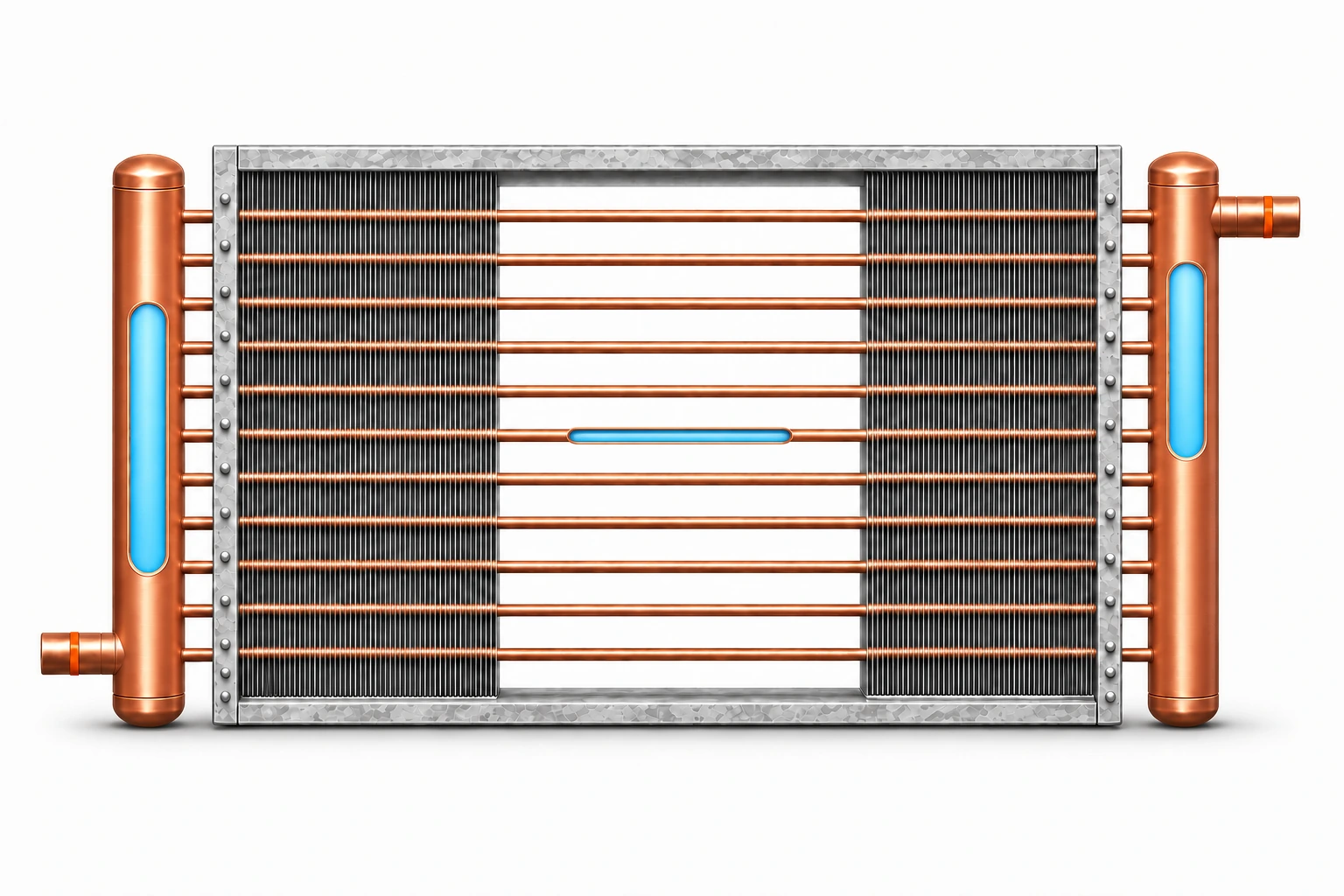
A pump circulates the mixture through the coil tubes. In a heating coil, the mixture gives up heat to the air. In a cooling coil, it absorbs heat from the air. Air passes outside the tubes and between the fins; the two streams stay separate during normal operation.
Think of the circulating fluid as a delivery vehicle for heat. It picks heat up in one place and carries it elsewhere. Adding glycol changes how that vehicle handles cold conditions, but also how easily it travels through the system.
This is different from the refrigerant in a direct-expansion evaporator. A water–glycol mixture normally stays liquid as it passes through a hydronic coil. The refrigerant in an evaporator absorbs heat partly by changing from liquid into vapor.
What ethylene glycol and propylene glycol mean
Ethylene glycol, often shortened to EG, is also called 1,2-ethanediol. Propylene glycol, often shortened to PG, is also called 1,2-propanediol. They are different chemicals with similar uses in heat-transfer systems.
A commercial glycol fluid is usually more than the base chemical. It can contain corrosion inhibitors and other additives, and may already contain water. The mixture circulating through the equipment is therefore best understood as a complete formulation.
An inhibited concentrate is a concentrated product containing protective additives, intended to be diluted according to its instructions. A premixed fluid already contains water at a stated concentration. Adding more water to a premix changes the protection it was supplied to provide.
Both base chemicals are essentially colorless. Manufacturers may add dye, but there is no universal color code that reliably distinguishes ethylene glycol from propylene glycol. A pink, green, or clear sample is not enough to identify what is in a system.
Why not use water alone
Water generally transfers heat well and is easier to pump than glycol mixtures at comparable temperatures. Where the equipment and exposure conditions allow it, a properly treated water-only system can be appropriate.
Glycol becomes useful when the fluid needs protection against freezing. That can include outdoor equipment, piping in unheated spaces, and process-cooling loops operating below water’s freezing point. A heating system can also be vulnerable during a shutdown, loss of heat, or circulation failure.
The tradeoff is that adding glycol changes the fluid’s heat-transfer properties and resistance to flow. A coil operating with glycol may deliver a different heating or cooling capacity from the same coil operating with water under otherwise comparable conditions.
There is no single percentage by which every coil loses capacity. The result depends on the mixture, temperature, flow, and coil design. Glycol is chosen for the protection the application needs, with those effects taken into account.
Why ethylene glycol mixtures usually flow more easily
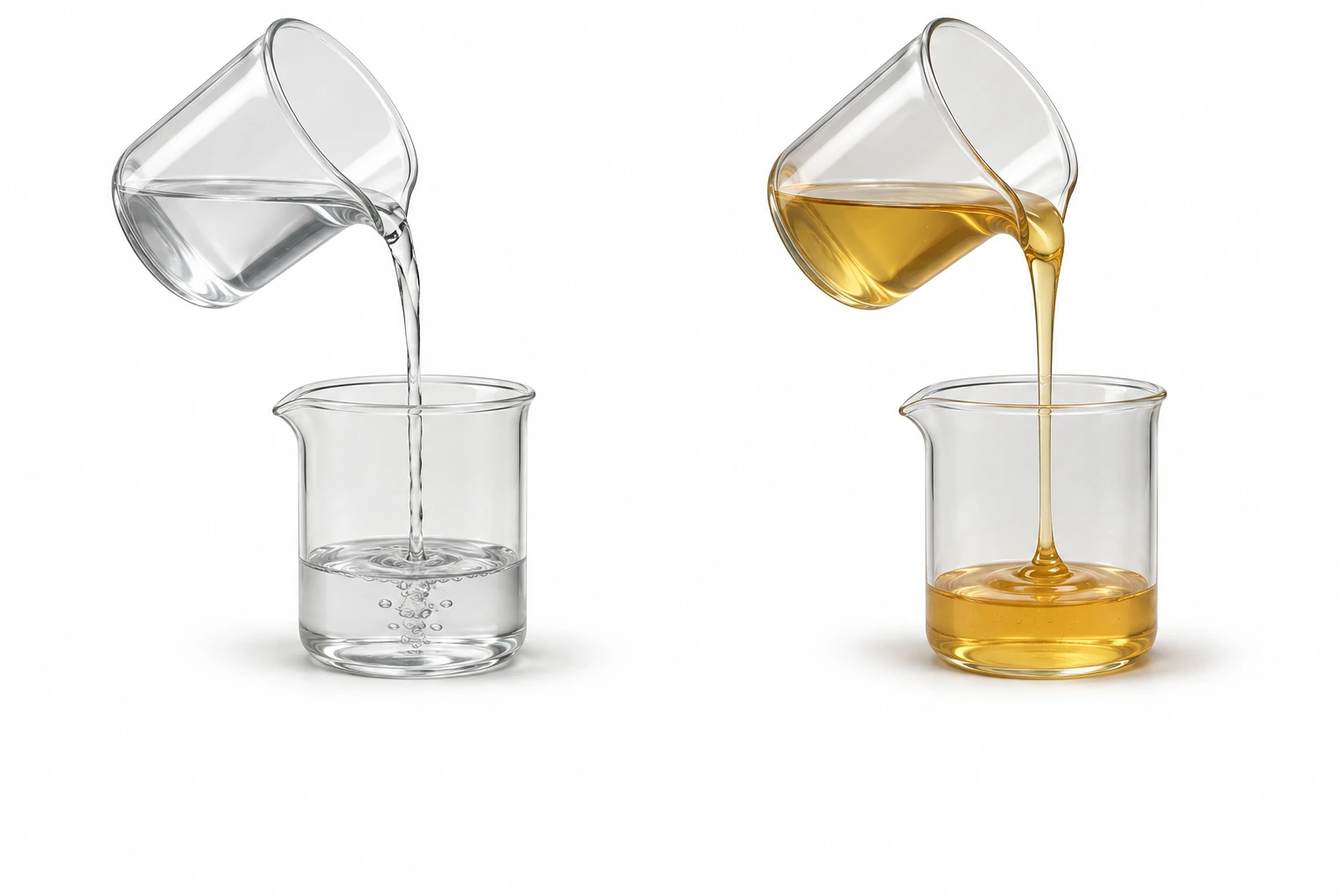
Viscosity means resistance to flow. Water pours easily; syrup resists flowing more. That is a useful way to picture viscosity, although it is not a literal comparison of the thickness of an HVAC glycol mixture.
At comparable temperatures and concentrations, ethylene-glycol mixtures are generally less viscous than propylene-glycol mixtures. The difference becomes more important as the fluid gets colder.
A more viscous mixture encounters greater resistance as it moves through tubes, valves, and piping. Depending on the system, maintaining the intended flow may require more pumping effort. With an unchanged pump arrangement, flow may decrease instead.
Viscosity also affects how effectively heat moves between the flowing fluid and the tube wall. Ethylene glycol’s lower viscosity is a major reason its mixtures often perform better in heat-transfer applications, particularly at low temperatures.
Heat capacity and thermal conductivity matter too. Heat capacity describes how much heat a quantity of fluid can carry for a given temperature change. Thermal conductivity describes how readily heat passes through the fluid. These are different properties, so “better heat transfer” should not be read as “higher in every property.”
What the toxicity difference means
Ethylene glycol can cause severe poisoning if swallowed, including kidney damage. Its use requires appropriate control of exposure and potential contamination.
Propylene glycol has substantially lower acute oral toxicity, meaning it is less toxic when swallowed in a short-term exposure. Certain grades are used in food, cosmetics, and medicines. That does not make a glycol mixture from an HVAC system suitable to drink.
The circulating fluid includes its additives and may also contain contaminants picked up in service. The safety information for the actual product matters, including its safety data sheet, or SDS, which describes hazards, handling, and related precautions.
For food-related applications, the exact formulation must be suitable for the intended use. For example, NSF’s HT1 category covers heat-transfer fluids where incidental food contact is possible. That is different from deliberately adding the fluid to food or allowing it to contaminate drinking water.
Choosing a lower-toxicity fluid also does not remove the need to contain leaks and handle the product properly.
When each mixture makes sense
Ethylene glycol can be a suitable choice for a controlled, closed-loop heating or cooling system where its toxicity is acceptable and its fluid properties suit the equipment. Its lower viscosity can be particularly useful in cold service.
Propylene glycol is often favored where lower toxicity is a priority, especially where accidental contact with food, beverages, or drinking water is a credible concern. The product’s complete formulation and suitability still need to match that exposure.
The building’s name alone is not enough to make the decision. A food-processing facility may have several separate circuits with different exposure risks. The useful question is where this particular fluid circulates and what it could contact if something fails.
Equipment requirements matter as well. Pumps, seals, valves, heat exchangers, and the metals in contact with the fluid must be compatible with the selected formulation and its operating conditions.
In an existing system, changing glycol type is a system-level change. A propylene-glycol mixture may not behave like an ethylene-glycol mixture at the same stated percentage. Compatibility, protection, flow, and heat transfer should be reviewed together.
What glycol concentration tells you
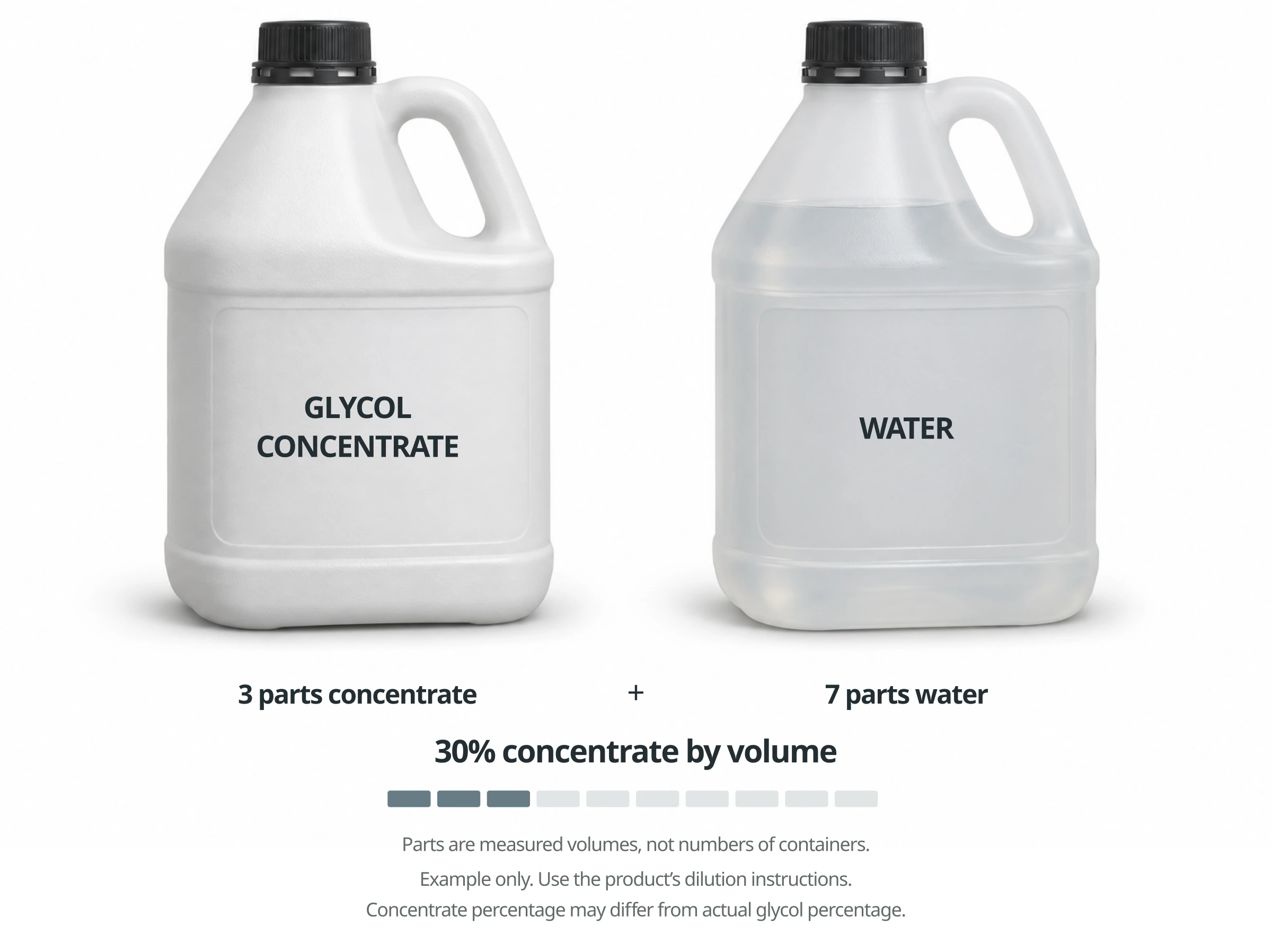
Concentration describes how much glycol is in the final mixture. However, a percentage is incomplete unless its basis is clear. A percentage by volume is different from a percentage by weight, and a percentage of a commercial concentrate is not necessarily the same as a percentage of pure glycol.
Think of concentration like a recipe. Changing the amount of one ingredient changes the result. In a glycol fluid, dilution changes both the amount of glycol and the concentration of the protective additives supplied with it.
More glycol is not automatically better. Increasing concentration generally makes the fluid harder to pump and changes its heat-transfer performance. Too little can leave inadequate freeze protection or too little inhibitor, depending on the formulation.
Use the chosen product’s concentration chart and instructions. The relevant conditions include the lowest temperature the fluid may experience during operation or a shutdown, and whether it must remain pumpable at that temperature. There is no universal 30 percent or 50 percent recipe for every coil.
Manufacturer-approved low-concentration formulations also exist, so a minimum percentage for one product should not be treated as a rule for all glycol fluids. The aim is an approved mixture that provides the required protection without unnecessary concentration.
Freeze protection and burst protection are different
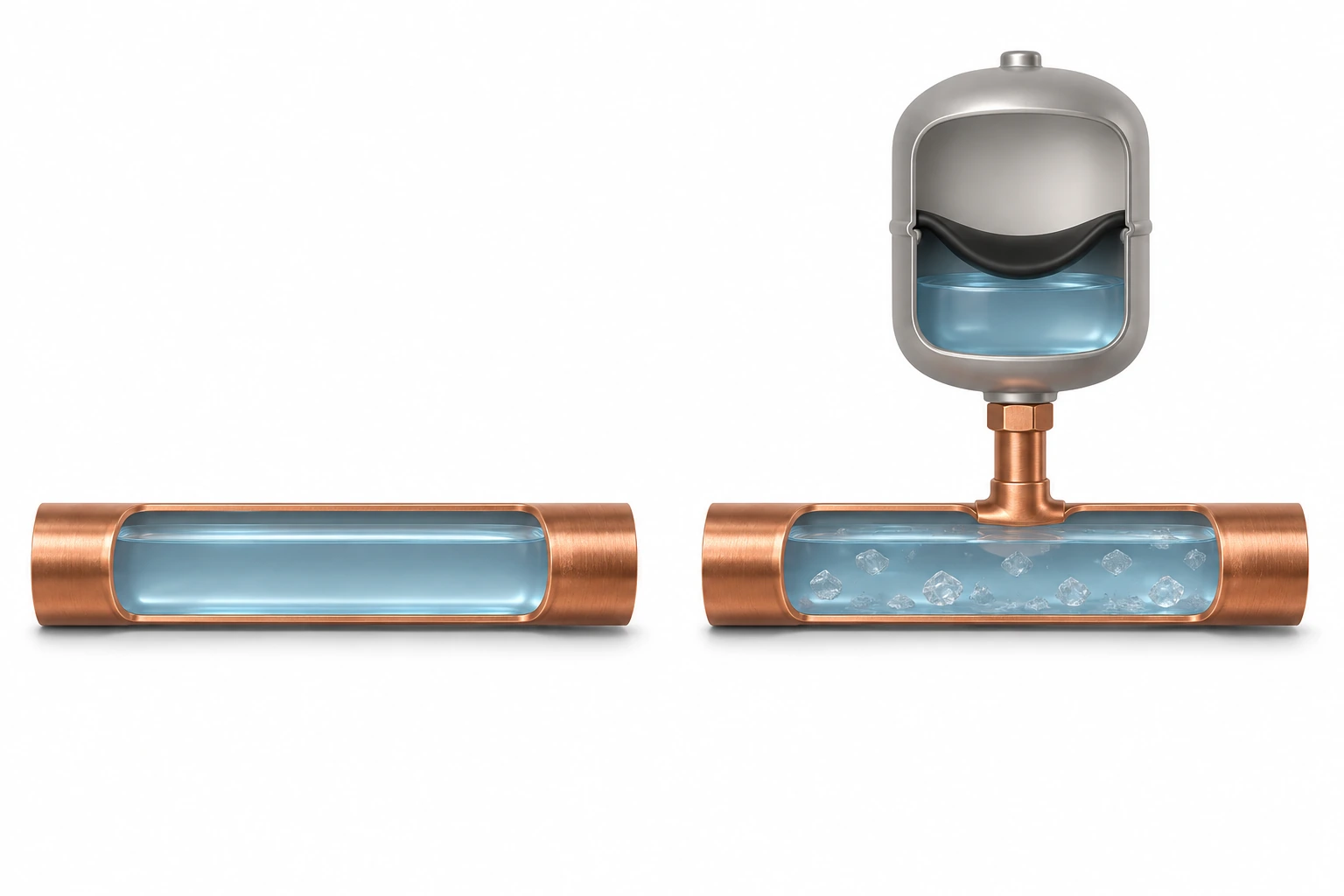
Freeze protection means selecting a mixture that prevents ice from beginning to form at the intended protection temperature. This matters when the system must keep circulating fluid or restart while it is still cold. The mixture’s viscosity must also remain suitable for circulation.
Burst protection addresses a different condition. Some ice and slush may form, but a suitable mixture and system arrangement allow expansion without rupturing the protected components. This depends on the application, including available expansion space.
A simple distinction is keeping a road open versus preventing the road from being damaged while it is closed. Freeze protection aims to keep the fluid free of ice for operation. Burst protection may help an idle system survive conditions in which normal circulation is no longer possible.
A burst-protection rating is therefore not a promise that the fluid remains fully liquid or suitable to pump. Do not use that rating as a substitute for freeze protection when the system needs to operate in those conditions.
Why the protective additives and water matter
Corrosion inhibitors are ingredients intended to protect the metals in contact with the fluid. Think of them as protective ingredients in the recipe: they serve a different purpose from lowering the freezing point.
Glycol can degrade over time, producing acidic compounds. A suitable inhibitor package helps control corrosion and buffer those changes. The correct additives depend on the system’s metals and operating conditions; one formulation is not automatically suitable for every material.
For a conventional fin-and-tube coil, focus on the surfaces the fluid actually touches, such as the inside of copper tubes and headers. Aluminum fins outside the tubes are normally on the air side. Their presence alone does not mean the circulating fluid contacts aluminum, although other equipment in the loop might contain wetted aluminum.
Dilution water matters too. Dissolved minerals and other impurities can contribute to deposits, corrosion, or loss of inhibitor effectiveness. Use water that meets the fluid manufacturer’s requirements, or a suitable premix. Do not assume any available tap water is acceptable.
Automotive antifreeze is not automatically interchangeable with a heat-transfer fluid specified for an HVAC system. Even when the base glycol is the same, additives may differ. Use a formulation approved for the equipment and application.
Identifying and maintaining an existing mixture
Start with the product label, system records, or reliable fluid identification. Do not choose a top-up fluid by matching its color.
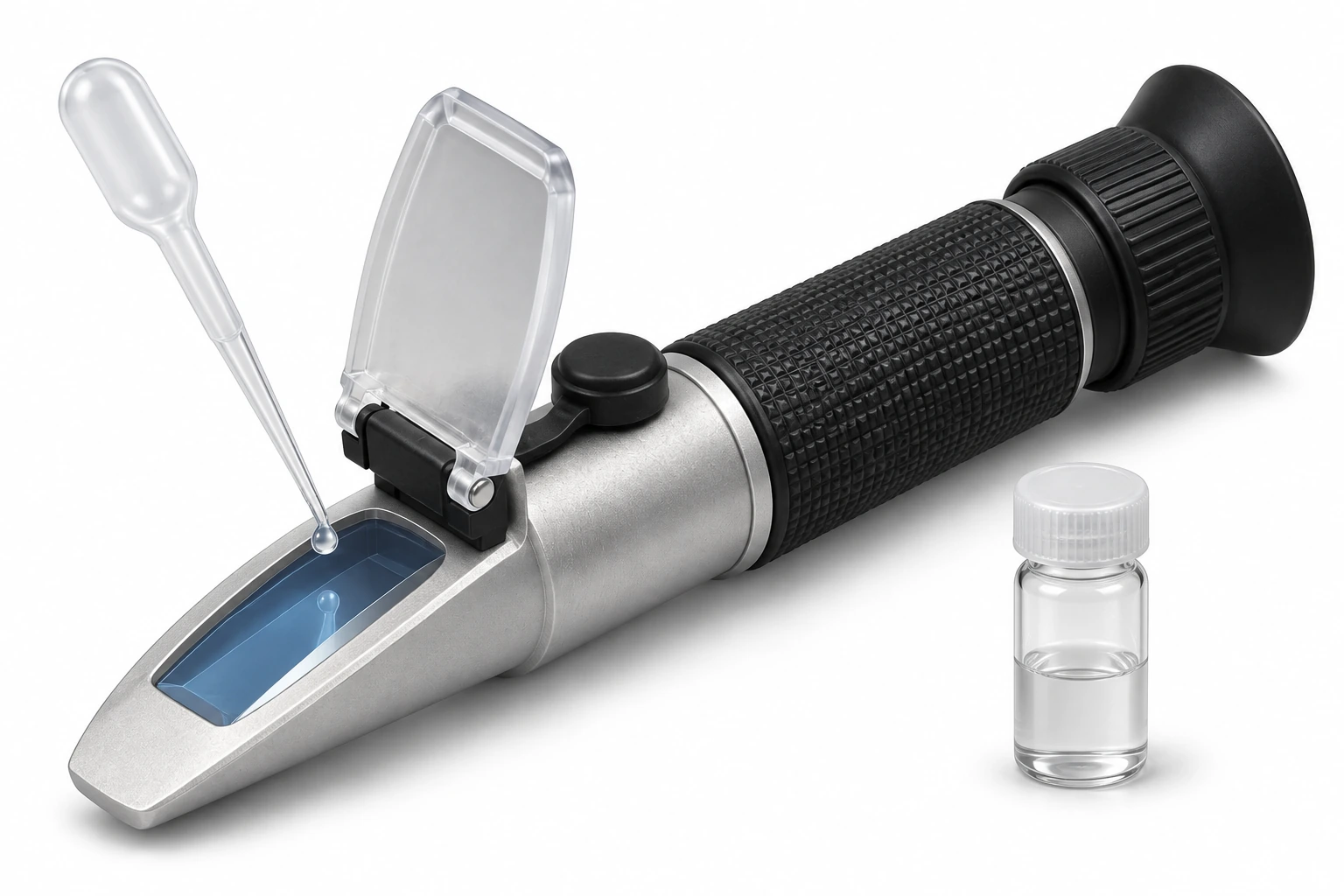
A refractometer is an instrument that uses the way a sample bends light to estimate concentration or freeze protection. It needs the appropriate scale or calibration for the known fluid. A reading does not, by itself, identify an unknown mixture or prove its inhibitors are still effective.
Fluid checks may include concentration, pH, inhibitor condition, and contamination. The manufacturer’s limits and testing recommendations should guide interpretation. A correct glycol percentage does not establish that the entire fluid is still in good condition.
Before combining products, verify compatibility with the fluid supplier. Different inhibitor packages may be unsuitable together, and adding ethylene glycol to a lower-toxicity propylene-glycol fluid changes its safety characteristics. Do not assume all products sharing the same base glycol are interchangeable either.
Adding plain water to replace a leak can dilute both glycol and inhibitors. Repeated topping up can therefore change the protection over time. Fluid identity, repairs, additions, and test results are useful records to keep with the system.
Spent fluid also needs appropriate handling. Follow the actual product’s safety data sheet and applicable disposal requirements; lower toxicity does not mean unrestricted disposal.
Comparing the two mixtures
Scroll horizontally on small screens to compare all columns.
| Comparison | Ethylene glycol mixture | Propylene glycol mixture |
|---|---|---|
| Main role | Freeze protection and heat transport | Freeze protection and heat transport |
| Resistance to flow | Generally lower at comparable temperature and concentration | Generally higher, particularly when cold |
| Toxicity | Can cause severe poisoning if swallowed | Substantially lower acute oral toxicity; formulation still matters |
| Typical selection reason | Useful performance where toxicity is acceptable | Lower toxicity where potential exposure matters |
| Food contact concerns | Generally unsuitable where accidental contact is possible | Use a formulation suitable for the intended exposure |
| Concentration | Use the selected product’s requirements | Use the selected product’s requirements |
| Corrosion protection | Needs a suitable inhibitor package | Needs a suitable inhibitor package |
Both mixtures can work well when they suit the application. The choice brings together exposure risk, cold-temperature operation, equipment compatibility, and the complete formulation. Once the type is chosen, concentration and fluid condition remain just as important as the name on the container.
Coil Recall
Review the article’s main ideas, one card at a time.
Card 1 of 7